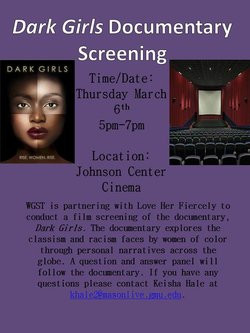
Women's History Month happens every spring semester in March. The Sojourner Truth Lecture is one of the occurring events and this year's speaker was Crystal Leigh who conducted a poetry workshop after her lecture.
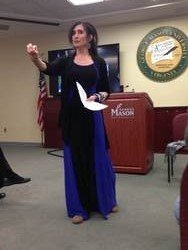
On March 5th, 2014, African and African American Studies and Women and Gender Studies held the annual Sojourner Truth Lecture in the Meese Room. The Sojourner Truth Lecture is held every year to bridge Black Heritage Month and Women’s History Month. This year’s lecturer was Dr. Crystal Leigh Endsley, Assistant Professor at John Jay College of Criminal Justice. Along with being an educator, Endsley is an internationally recognized spoken word artist, activist, and actress.
Endsley’s pieces explore performance and identity and how they interact with feminist pedagogy, race, and popular culture. As an activist, she incorporates cultural production and uses it to address academic/home communities, motherhood, and knowledge production. Her lecture titled “Everything I Never Had” illuminated her experiences with community isolation in university settings, performance in daily life in relation to meeting white standards, and finding strength through spoken word expression.
Throughout the lecture, Endsley integrated spoken word and poetry into her speech. Her performances brought to light the experiences of coming from a racially mixed family, surviving trauma, and finding strength when the world tries to “take away your fire.” In addition, Endsley incorporated the audience into the performance by passing around a notebook where audience members could write under the prompt of “Everything I Never Had”. At the end of the event, a student read the piece to the audience which shared everyone’s experiences.
The event was well-attended by faculty, staff, and students with a reception that followed. Endsley also hosted a poetry workshop the evening after the lecture for anyone interested in spoken word or poetry.
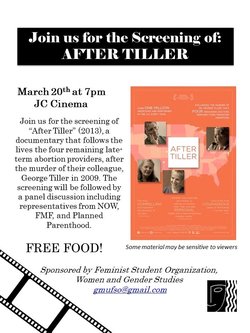
After Tiller Film Screening
On Thursday, March 20th, the Feminist Student Organization screened “After Tiller”: a documentary which discusses reproductive rights and ideologies behind abortion providers. Before Dr. Tiller was assassinated, he provided late-term abortion services to people in their third trimester of pregnancy. He was one of five doctors in the country who is qualified to do so. The documentary followed the remaining four doctors and examined their thoughts about Dr. Tiller, their interactions with patients, and their opinions of why people should have access to late-term abortion services. The patients’ stories also explored various reasons why parents decide to have late-term abortions, including debilitating fetal illnesses, ability to support another child, or not wanting a child in general.
After the film, a panel followed which included members of the National Organization for Women, the Feminist Majority Foundation, and Planned Parenthood. The panelists discussed the multiple barriers that people face when they try to access abortion services in the United States. Such topics included navigating specific state-wide restrictions on abortion, barriers that limit access like proximity and ultrasounds. In regards to late-term abortions, they also brought up how the doctor’s decision as to whether or not a pregnancy is too far along for the procedure can be a limiting factor in obtaining abortion services. The panelists provided their thoughts based on their background working for women’s rights organizations and were able to provide perspectives about national access to abortion and how their work related to reproductive rights.
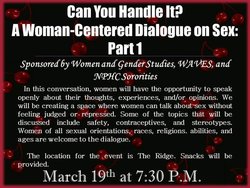
Can You Handle It?: A Woman-Centered Dialogue on Sex
On Wednesday, March 19th, Women and Gender Studies, Wellness, Alcohol, and Violence Education and Services, NHPC Sororities, and Pan Hellenic members held the first part of a dialogue series centered on sex. The event began with everyone in attendance writing on various posters their reactions to the words “sexuality, sexual orientation, celibacy, sex and empowerment, and stereotypes about women”. Afterwards, the group entered a discussion about their perceptions of the terms and how they felt about what was written about the terms. Various students explored double standards regarding the amount of sexual partners men can have versus women, slut shaming, rape culture, and asexuality.
Once the discussion ended, the group viewed a video about sexual assault. The video displayed a situation where a student was at a party, drank, and was sexually assaulted by a man at the party. As the video progressed, it showed the stories of various people throughout the night that could have prevented the assault by either making sure the woman got to safety or simply checking if she could find the rest of her friends. At the end of the video, they played the night out in reverse and showed what the bystanders could have done to take action and prevent assault. The video raised awareness of the importance of speaking up and looking out for others in situations where drinking is involved.
Finally, Wellness, Alcohol, and Violence Education and Services (WAVES) presented an informational session about different forms of contraceptives and their benefits and detriments. Angela Johnson informed the group about internal/external condoms, birth control pills and patches, IUDs, cervical caps, and more.